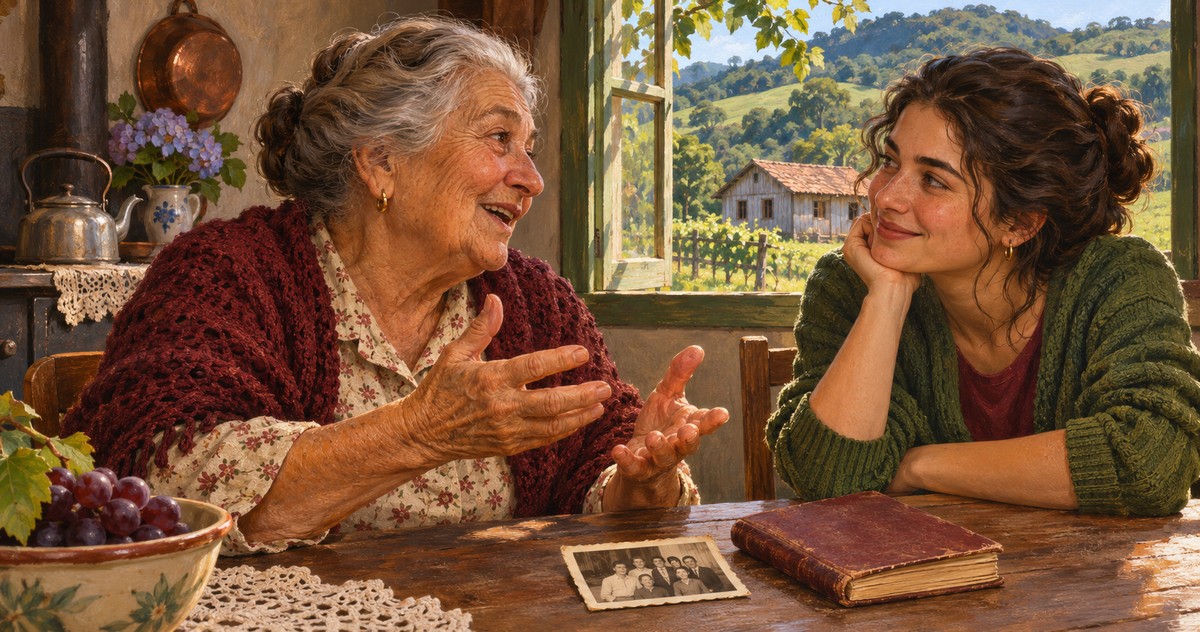
Family stories can endure in the words used to call people to the table, in a song or in a conversation between generations. In many Brazilian communities of Italian origin, that memory has a voice: Talian, also known as Brazilian Venetian or Vêneto do Brasil.
Knowing this language means discovering part of the Italian experience built outside Italy. Its value lies in its speakers, in the stories it enables them to tell and in the possibility of passing this heritage on.
What is Talian?
Talian is a Venetian-based immigration language that developed in Brazil. It emerged through contact between speech varieties brought by immigrants from northern Italy, particularly Veneto, and Brazilian Portuguese. UFSM explains this development through the need for communication between communities of different origins.
Scholars also use the term koine: a shared means of communication that develops through contact between speech varieties. The Iphan inventory documents this history, the language’s names and local differences. Talian’s history therefore involves both continuity and change.
Why is it also called Brazilian Venetian?
The name highlights its Venetian basis and the place where it developed. However, Talian is not identical to the language spoken in Veneto today. Professor Luciana Lanhi Balthazar, in an article published by the Brazilian Association of Teachers of Italian, emphasizes its Brazilian development and contact with Portuguese.
Talian, Venetian and Standard Italian are historically related, but their names are not interchangeable. Natália Brambatti Guzzo’s study also explains that Talian is not a variety of Standard Italian. Learning Italian and preserving Talian can be complementary projects: each provides access to culture in its own way.
Where is the language spoken?
Southern Brazil is central to this history, particularly Rio Grande do Sul, Santa Catarina and Paraná. Iphan also records communities in other states, including Espírito Santo, Mato Grosso and Minas Gerais. This presence does not mean that every family of Italian origin speaks Talian or that it is uniform everywhere.
This article does not present a speaker total as though it were a current census. Speaking fluently, understanding conversations and feeling an emotional connection with a language are different situations. A more immediate question for readers might be: who still speaks Talian in my family or community?
Imposed silence and its consequences
During the Estado Novo dictatorship, from 1937 to 1945, the nationalization campaign targeted immigration languages and their speakers. Victor Bertholdo Rocha’s research at Unila examines measures of control and repression directed at these populations. The Talian community inventory also describes stigma and the social devaluation of their speech.
This history belongs in any discussion of transmission between generations. Expecting a family simply to have maintained its language overlooks pressures it may have faced. Sangue Merito’s position is that recovering this memory requires respect for speakers and for people who lost the opportunity to learn.
Cultural recognition in 2014
Federal recognition has a precise documentary record: the title issued by Brazil’s Ministry of Culture records Talian’s inclusion in the National Inventory of Linguistic Diversity on September 9, 2014. The document granting it the title of Brazilian Cultural Reference was signed on November 10 that year, under Decree 7,387/2010, which established the INDL.
This is cultural recognition through that instrument. Municipal co-official status is a separate measure with local scope, dependent on its own legislation. Distinguishing these initiatives helps explain what each recognition means.
Cities where Talian has co-official status
Among the cities mentioned in the Alma article, the municipalities below have laws explicitly naming Talian as a co-official or second official language alongside Portuguese. Each reference links to the legislation so readers can check its scope.
- Coronel Pilar (RS) — Law no. 1.022/2023: Talian.
- Encantado (RS) — Law no. 5.048/2023: Italian and Talian.
- Fagundes Varela (RS) — Law no. 1.922/2016: Talian.
- Farroupilha (RS) — Law no. 4.749/2022: Talian.
- Ijuí (RS) — Law no. 7.421/2023: Polish, Hunsrückisch and Talian.
- Pinto Bandeira (RS) — Law no. 414/2019: Talian.
- Serafina Corrêa (RS) — Law no. 2.615/2009: Talian.
- Vila Flores (RS) — Law no. 2.541/2022: Talian.
- Venda Nova do Imigrante (ES) — Law no. 1.676/2024: Italian and Talian.
This is a selection of municipalities mentioned in the initial reference, not a complete national list of Talian co-officialization laws. The Brazilian Repository of Linguistic Legislation, produced in collaboration with IPOL, lists further legislation. A law’s existence should also be distinguished from implementation of the measures it provides for.
When legislation names Italian without naming Talian
The initial reference also mentions the four cities below. The acts examined use the name Italian without explicitly mentioning Talian. These laws alone were therefore not used to classify Talian as co-official in those municipalities. Preserving each law’s wording avoids automatically treating Italian and Talian as legally equivalent.
- Santo Ângelo (RS) — Law no. 4.797/2025: Polish, Italian and German.
- José Boiteux (SC) — Law no. 1.299/2025: Xokleng, Italian and German.
- São Bento do Sul (SC) — Law no. 5.181/2025: German, Polish and Italian.
- Santa Teresa (ES) — Law no. 2.812/2021: Italian.
Legislation checked on November 21, 2026. RS: Rio Grande do Sul; SC: Santa Catarina; ES: Espírito Santo.
A heritage that keeps moving
In February 2026, Iphan announced a book and a safeguarding project involving 41 municipalities in the Serra Gaúcha. The survey documented more than 500 initiatives, including teaching, radio, choirs, theatre and collections. These are practical efforts to sustain the language’s use.
Another important legacy is that of Darcy Loss Luzzatto (1934–2020). In 2024, Iphan reissued his Portuguese–Talian and Talian–Portuguese dictionaries. Cucagna – Scola de Talian, presented by Unicentro, is a partnership with the Association of Talian Promoters, Assodita, supporting dissemination and safeguarding. Its institutional page provides information about the project; course dates and availability should be checked with the organizers.
Bringing younger generations closer
Preserving a language begins with making room for it. Families and communities can take practical steps:
- Ask older people about words, stories and places they consider important.
- Record stories and conversations with participants’ agreement, noting names, place and date.
- Listen to work produced by speakers and seek learning projects with identifiable references.
- Value local differences without embarrassing people who speak differently or are beginning to learn.
- Share contexts and meanings with children and young people, giving the language a use beyond remembrance.
For Sangue Merito, the Italian diaspora should also be understood through the culture it has built. Talian is part of that collective creation. Studying Italy today and listening to the language preserved by Brazilian communities can go hand in hand.
A language continues when people want to listen, learn and use it. Making room for Talian means recognizing what we have received and creating conditions for other generations to receive it too.
References and further reading
Institutional and academic sources are linked throughout the text. The article on Talian published by Alma Cidadania Europeia was also consulted as the starting point for this topic.