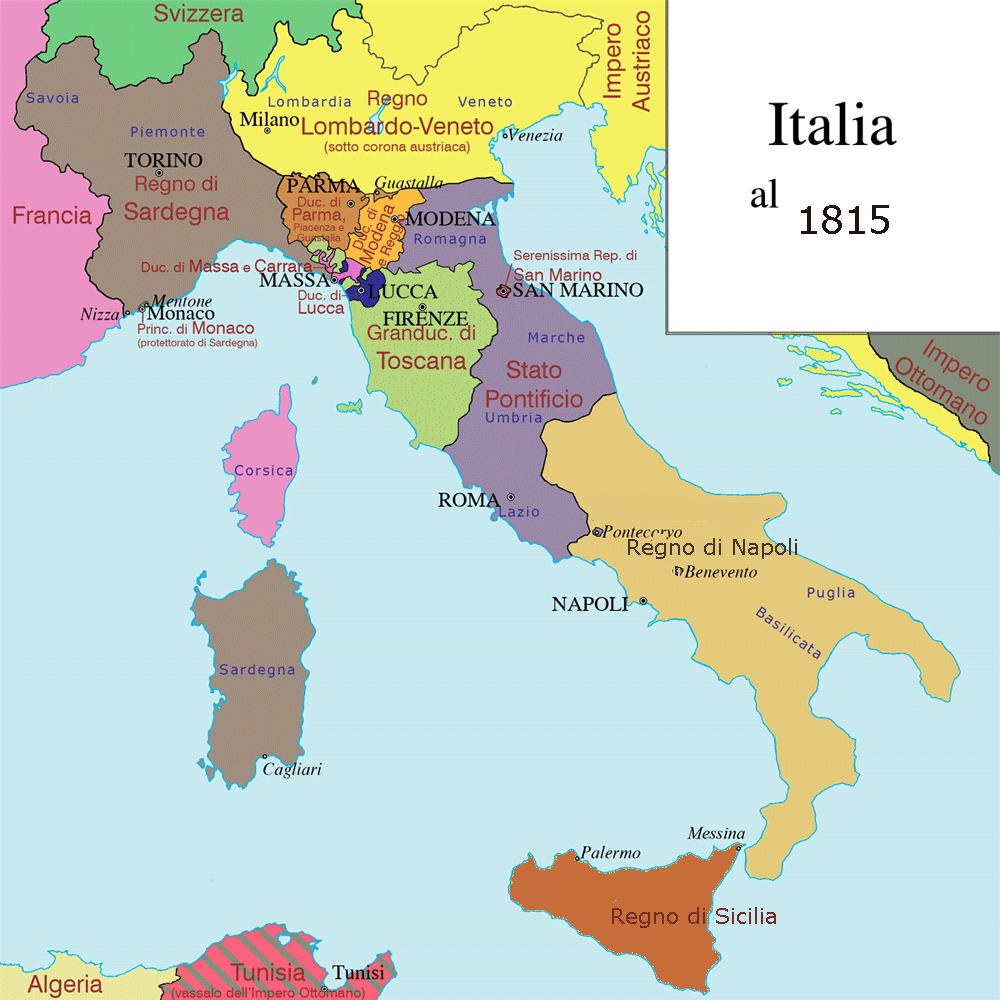
Before there was a single Italian state, the peninsula was a mosaic of kingdoms, duchies, pontifical territories and areas subject to the influence of great European dynasties.
1815Congress of Vienna
10 formationsincluding the Republic of Venice
1861proclamation of the Kingdom of Italy
Italian states after the Congress of Vienna in 1815. Map by Bramfab/Artemka, Wikimedia Commons — CC BY-SA 3.0.
After Napoleon
The Congress of Vienna redesigned the peninsula
With Napoleon's defeat, the Congress of Vienna restored dynasties and reorganized Europe. On the Italian peninsula, former sovereigns returned, Austria expanded its influence and the borders were restored.
There was no Italian citizenship, national government or common capital. A person was a subject of the king of Sardegna, the king of the Two Sicilies, the Austrian emperor, the pope or a ducal sovereign, depending on the place of birth.
From the Republic of Venice to the map of 1815–1859
The main pre-unitary states
Some were extensive kingdoms; others, smaller duchies. We also included Venice, which became extinct in 1797, because its long history is indispensable for understanding Veneto and the map that emerged later.
RS
Capital: Turin
Kingdom of Sardegna
House of Savoia
It brought together Piedmont, Valle d'Aosta, Liguria, the island of Sardegna, Savoia and Nice. It became the political and military center of the unification process under Vittorio Emanuele II and Cavour.
The institutional engine of the Risorgimento.
VR
Capital: Venice
Republic of Venice
La Serenissima
A maritime and commercial power formed in the Middle Ages, it governed Venice and extensive territories in the northeast of the peninsula, the Adriatic and the eastern Mediterranean. Its republican organization was led by the doge and aristocratic councils.
It came to an end in 1797, with the Napoleonic invasion and the Treaty of Campoformio; its territories passed through French and Austrian administrations.
LV
Centers: Milano and Venezia
Lombard-Venetian Kingdom
Austrian Empire
Created in 1815 under the Austrian Crown, it comprised Lombardy and Veneto. Resistance to Vienna's rule played a central role in the Risorgimento revolutions and wars.
Lombardy passed to Piedmont in 1859; Veneto, to Italy in 1866.
D.S.
Capital: Napoli
Kingdom of the Two Sicilies
House of Bourbon-Two Sicilies
Formed in 1816 by the union of the kingdoms of Naples and Sicily, it covered the entire continental south and the island. It was the largest state on the peninsula in terms of territorial extension.
It was incorporated after the Thousand Expedition and the plebiscites of 1860.
EP
Capital: Rome
Papal States
Pope's temporal sovereignty
They extended across the center of the peninsula, including Lazio, Umbria, Marche and part of Romagna. The pope simultaneously exercised religious authority and territorial power.
Rome was incorporated into the Kingdom of Italy in 1870.
GT
Capital: Florence
Grand Duchy of Tuscany
House of Habsburg-Lorraine
It brought together a large part of present-day Tuscany and preserved a strong administrative, intellectual and artistic tradition. The dynasty left power during the transformations of 1859.
Annexation to Piedmont was approved by plebiscite in 1860.
PR
Capital: Parma
Duchy of Parma and Piacenza
Maria Luísa and then the Bourbon-Parma
After 1815 it was handed over to Maria Luísa of Austria, former wife of Napoleon. In 1847 he returned to the Bourbon-Parma dynasty and, in 1860, joined the Piedmontese process.
Territory today associated with Emilia-Romagna.
MR
Capital: Modena
Duchy of Modena and Reggio
Austria-Este House
Ruled by a branch of the Habsburgs, it included Modena, Reggio, Mirandola and, at different times, Massa and Carrara. It was shaken by revolutionary movements.
It joined the Kingdom of Sardegna in 1860.
LU
Capital: Lucca
Duchy of Lucca
House of Bourbon-Parma
Created by the Congress of Vienna as a temporary solution for the Bourbon-Parma. It existed until 1847, when it was incorporated into the Grand Duchy of Tuscany.
An example of how the map changed even before 1861.
SM
Capital: San Marino
Republic of San Marino
independent republic
A small republic surrounded by the peninsula, its independence was recognized at the Congress of Vienna and welcomed refugees linked to the Risorgimento.
It was not annexed and remains sovereign to this day.
Geography of origins
From ancient states to current regions
For genealogy, understanding these borders avoids a frequent error: looking for an ancestor from the beginning of the 19th century as if he had already been born in the Kingdom of Italy.
NorthwestKingdom of Sardegna
Piedmont, Liguria, Valle d'Aosta and Sardegna, in addition to Savoia and Nice, later ceded to France.
NortheastVenice, Lombardo-Veneto and Austria
Veneto preserves the heritage of the Serenissima, which ended in 1797. After Napoleonic changes, Lombardy and Veneto were reunited under the Austrian Crown in 1815.
North CentralDuchies and Tuscany
Emilia-Romagna and Tuscany preserve archives produced under Parma, Modena, Lucca and the Grand Duchy.
CenterPapal States
Lazio, Umbria, Marche and part of Romagna were under pontifical temporal administration.
South and SicilyKingdom of the Two Sicilies
Abruzzo, Molise, Campania, Puglia, Basilicata, Calabria and Sicily shared the bourbon monarchy.
Historical archivesThe State defines the document
Civil certificates, military records, passports and notarial acts may follow rules, languages and administrations prior to unification.
From mosaic to Kingdom
The path to unification
Revolts, diplomacy, wars and plebiscites successively altered the borders. The 1861 proclamation was decisive, but Veneto and Rome would still be incorporated later.
End of the Republic of Venice
The Napoleonic invasion ends Serenissima. By the Treaty of Campoformio, Venice and part of its territories were handed over to Austria.
Congress of Vienna
Dynasties are restored and Austrian influence returns to dominate much of the peninsula.
First revolts
Constitutional and national movements are repressed in different states.
Revolutions
Insurrections, republics, and the First War of Independence make unity a European issue.
Lombardy and central Italy
The war against Austria and political changes pave the way for new annexations.
Expedition of the Thousand
Garibaldi conquers the Kingdom of the Two Sicilies; plebiscites integrate territories into Piedmont.
Kingdom of Italy
Vittorio Emanuele II is proclaimed king of Italy, with capital in Turin.
Veneto
Veneto is incorporated after the Third War of Independence.
Rome
Entry into Rome ends pontifical territorial sovereignty over the city and completes the central stage of unification.
We use session cookies to operate the site. With your permission, we use Google Analytics to understand visits. You can decline statistics and continue browsing normally. Privacy and cookies